Egerton 1821 really isn't an expensive book. It is a parchment codex (rather then velum),It's definitively velum extremely small, and has woodcuts (rather than hand painted images). I'm uncertain how valuable red paint/ink was during this period, but I conject that one of the reasons for adding so much blood to this book and painting the woodcuts could be to increase its perceived value without actually spending that much money.
In a way it's like adding a loud muffler to a Hyundai civic: in the end it is still a cheap car, but at least it sounds cool... Except this Hyundai has extreme religious significance and meditative utility which are things you can't really put a price on.
There's nothing quite as fun as burning bloody corpses after a battle!
Late 15th c German manuscript.
So far my study has looked only at the religious reasons for having a book filled with bloody imagery. In today's post I take a deviation to explore non-religious violent depictions of blood in late medieval literature and art. My goal is to demonstrate how blood could not only be appreciated for its devotional aspects, but also for being, well, entertaining. I guess my general point for this post is that while Egerton 1821 is intrinsically religious, there is something just awesome in both the modern and medieval imagination about having a book literally dripping with blood.
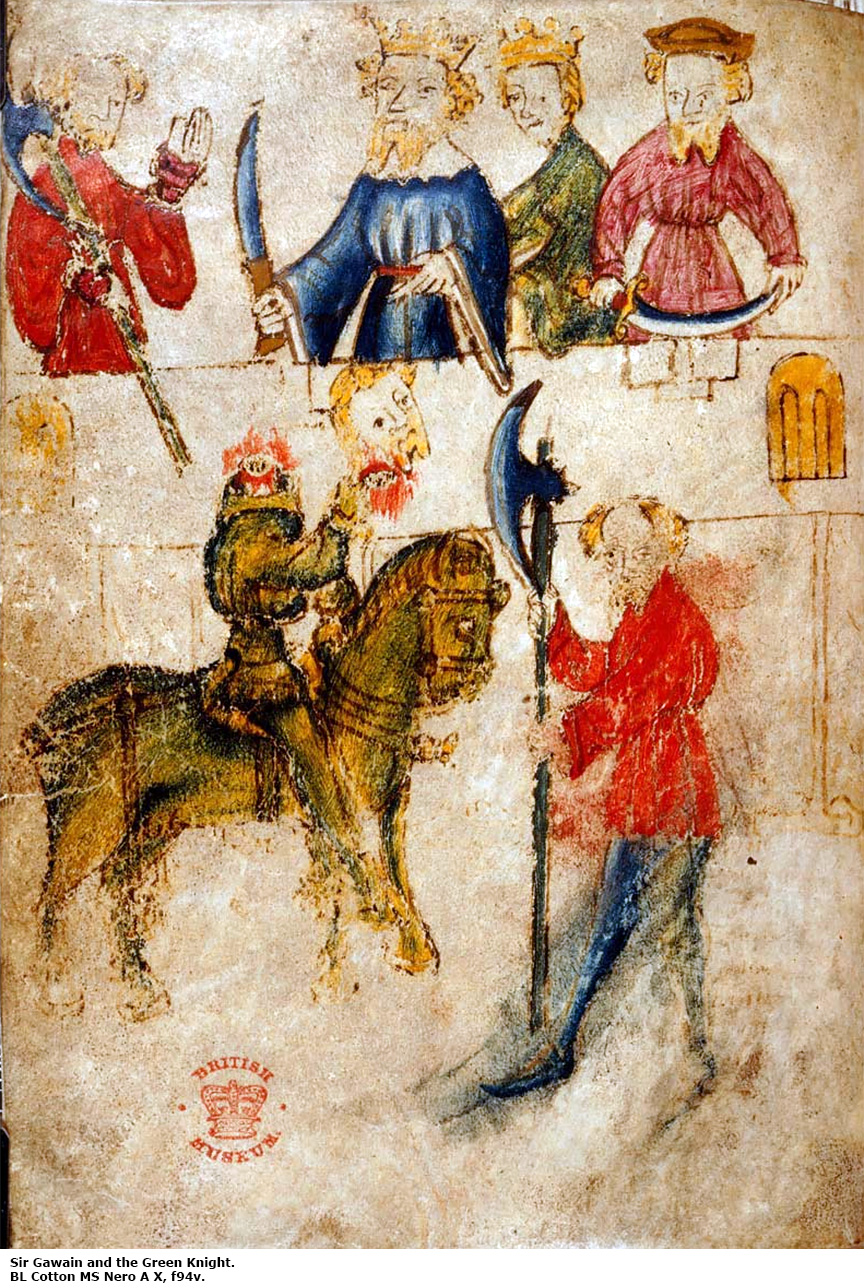
The Green Knight retrieves his bloody head.
BLondon, British Library MS Cotton Nero A.x. (art. 3)
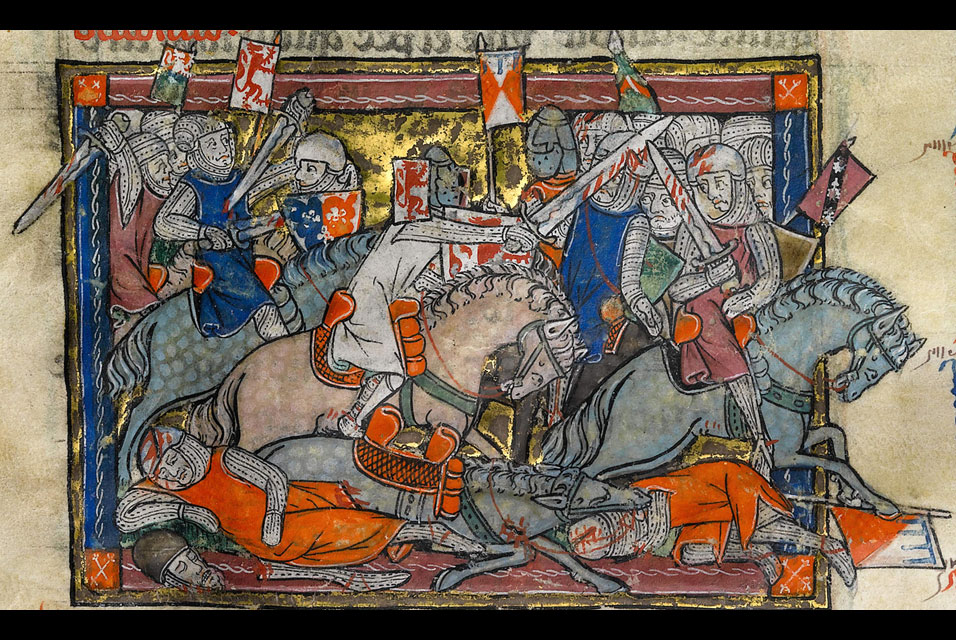
One of the most popular genres of the late middle ages, the chivalric romance, has violence and competition as its centerpiece. The most famous violent death of this tradition (and perhaps of all literature) is that King Arthur at the hands of Mordred.
John Boorman's cheesy, yet sufficiently bloody take on the scene in Excalibur
Malory, first publishing his famous Le Morte D'arthur in 1485 (almost the exact same date as Egerton 1821) describes it for us in quite gritty detail.
"Then the king gat his spear in both his hands, and ran toward Sir Mordred, crying: "Traitor, now is thy death-day com!." And when Sir Mordred heard Sir Arthur, he ran until him with his sword drawn in his hand. And there King Arthur smote Sir Mordred under the shield, with a foin of his spear, throughout the body, more than a fathom. And when Sir Mordred felt that he had his death wound he thrust himself with the might that he had up to the bur of King Arthur's spear. And right so he smote his father Arthur, with his sword holden in both his hands, on the side of the head, that the sword pierced the helmet and the brain-pan, and therewithal Sir Mordred fell stark dead to the earth.|
Some glorious blood and guts in the Rochefoucauld Grail manuscript
Why Malory chose to describe in detail Mordred pulling himself up his father's spear to smack out Arthur's brains when his predecessors didn't is up for debate. I figure it's simply to add entertainment.
By some standards however, the Arthur legends are rather tame. To end this post I would like to briefly look at the middle English Siege of Jerusalem which is perhaps the most violent piece of literature I have ever come across. Written in the 14th century, it tells of how Vespasian and Titus (for some reason baptized as christian knights) besiege Jerusalem over a period of years. It is extremely anti-Semitic and describes the ruthless slaughter of Jews (also anachronized as chivalric knights) in very gory detail throughout.
Firing severed heads at enemies in the holy land.
Some of the violence in the piece is certainly religious. It opens with a description of the Crucifixion and later provides reversals to it. Take the execution of Caiaphas for example (who is for some reason, despite being probably around the age of 90 at the time... portrayed as the leader of the Jewish army).
“They bound the bishop in so vile a
way
That blood burst out from under each
binding
And they brought all the
beaux-clerks up to the belfry,
Where the battle standard stood, and
positioned them there”
Other bloody imagery in the book is
however straight nonsensical entertainment.
“And Titus turns toward them
without another word…
…And many men spear gored with a
sharp end.
Beaming iron and mail-coats were all
drenched in blood,
And
many men at that assault sought the ground”
And as the poem progresses, the more
and more insane it gets.
"Castles clatter to the ground, camels burst open,
Dromedaries meet with their death very quickly--
The blood foamed from them into great motionless pools,
So that steeds were knee-deep as they dashed through the valley."
Yeah...
"He slew six on the wall, Sir
Sabin alone--
But the seventh strikes him a brutal
blow,
So that the brain bursts out both
nostrils,
And Sabin falls into the ditch, dead
from the blow."
Sigmund Meisterlin' codex
14th Century Germany
In short, blood is fun. While its appearance in a medieval context will will always make us think back to Christ, we should not always assume that is its only intent. Egerton 1821 is certainly a religious book. However, I think it would silly to dismiss the entertaining factors the blood may have provided the reader.
This post is a short update of where my research has taken me recently, and where I plan to go with it in the coming weeks.
Woodcuts
I've recently looked into the woodcuts. It appears that very similar, or even identical woodcuts to the ones in this book were very popular during the early 16th century (particularly the man of sorrows and arma christii). Unfortunately manuscripts are more likely to be digitized than print texts, so it is very difficult to find codices containing the same prints online. What images I have come across are found are in blogs or grey literature websites that offer little information on their context. From what I can tell very few of these woodcuts received coloring as they did in this codex. It would make me very happy to find a devotional book (even a print book) with the same woodcuts as this one to see if they also had evidence of kissing or rubbing.
Crossed out text on F8v
Since this project is for a course on text image relationships, I figured it would be a good idea to attempt deciphering the crossed out middle English on folio 8v. It is very clearly an indulgence, and runs something along the lines of the following.
"To all the devout, lay (say?) ...x... and be granted xxxiim... (over 30,000?!) years of ...pardon...?"
It would be interesting to know when the text was crossed out, as a rejection of the indulgence could be used to argue why f2r was the target of physical devotion instead.
While the culprits could be militant protestants modifying the text in later years, I think it is possible that indulgences were seen with disdain in the late 15th century and that the patron immediately crossed out the text. In the 14th century we have Chaucer famously deriding pardoners and their relics in the Canterbury Tales, so I see no reason why print indulgences would seen in any better light a century later. A very similar (but not identical) woodcut with possibly the exact same text also crossed out can be found on this blog. Evidently the sentiment was widespread. Upcoming goals
In the coming weeks I'm hoping to look more deeply into the significance of blood in late medieval devotion since my arguments could really just as easily be made had the book been covered with blue tears and rainbows. From what I have read so far, bloody imagery appears to have been very popular in Germany in the late middle ages. Is this codex is an example of cultural diffusion?, or has modern scholarship on the topic simply concentrated on Germany? I guess I'll have to find out.
In this post I start developing my thesis, expand my bibliography,
and provide a number of parallels (comparanda) which I may use further on in this project.
Thesis
While I have yet to come to a definitive thesis for this study, I've managed
to narrow it down to a few research questions, all relating to folio 2.
1. Why isf2rworn? The British Library
tentatively offers kissing; however looking at the page closely, it appears almost as if it
was intentionally rubbed/scraped away. Regardless of the cause, all could
be argued as a case of a lay devotion trying to imitate clerical practice.
2. If the damage was the result of kissing or rubbing, why did the reader
choose this page rather than the woodcut images? I forward that the reader(s)
may have done so due to presence of a woodcut image of the virginon
its verso, perhaps in the knowledge that such behavior on the
woodcut itself would deteriorate it. It would be interesting to see
if images of the virgin are more likely to be physically interacted with in
other manuscripts than other types of imagery.
3. This inherently leads to the question as to why this was not followed up on
subsequent folios, particularly folio 8 which hasbleeding
wounds on its front, and awoodcut
image of the arma christiion
its verso. The opening three pages are the only case in this book where
blood is not flowing from a visible wound or subject. I conject that the
absence of wounds in the opening pages may suggest to a devotional device
intentionally inserted by the manuscript’s creator which had the readers meditating
on the blood and imagining the wounds on themselves. Perhaps then the reason
for only this page receiving repeated physical interaction is the result of the strong
meditative connection. How to make this claim beyond conjecture will be my
biggest challenge going forward in this project.
Comporanda
Ebstorf Map
Likely a 13th Century German production.
Despite being out of context time, location and subject wise, this map has a lot to say on the topic of my argument. If one looks closely at the edges of the circular map, the head (depicted as the Veronica?), left and right hands, and pair of feet of Christ are depicted on each direction. The implication is that the map itself is Christ's body (or at least the reader is intended to imagine it as such). Compare this with f9r of our book.
Egerton 1821 f9r
Here we have a very similar situation. No body (or head in this case) is provided, just bloody hands, feet and a heart pierced by the holy lance. It is ultimately up to the reader to imagine the rest of Christ. Whether they did so by imagining their body as Christ's (in order to try and feel his pain (creepy...)) or simply took the pierced heart as a symbol for the rest of Christ is debatable.
The point I'm trying to get across with this comparison is that the corporeality of Christ's ...corpus... seems to have fluctuated in the medieval imagination. Sometimes it is depicted naturally (to a degree...) as in f8v, is depicted as something else (the map, f9r, and perhaps even the communion where bread and wine are imagined literally as the blood and body of Christ), or is left up to the viewer's mind entirely (as I suggest in f2r).
Painted woodcut featuring St. Bridget and Christ
This late 15th/early 16th image of St. Bridget praying before Jesus is perhaps the best analogue I have been able to find to imagery of BL MS Egerton 1821. It's a woodcut, it has Jesus, we have painted blood, it's housed in the British Library! Too good to be true?
Unfortunately so.
Turns out the woodcut was cut out of a codex along with some other images leaving us with little to no information on the book that housed it. It's inferred that this cut, and others related to it have their origin in a Flemish Brigittine convent. From what I have been able to tell, this is the only woodcut known from the manuscript with bloody imagery making it doubtful that the original book much resembled BL MS Egerton 1821. However, it would be great to confirm that it didn't have a similar kissing ritual or bloody pages as our books does.
There is a recent book on anchoritism in the middle ages which this image fronts. I'm hoping to get my hands on a copy before I conclude this project in the hopes that it may provide more detail on this image than what the British Library offers. With our book apparently being intended for a woman, perhaps some insight could be gleamed regardless of whether information is offered on the Bridget image.
In this woodcut we again come across an imagined body. This case has the body of Christ imagined as a wound and is accompanied by text which identifies that a seven year indulgence is offered if kissed.
Here we have kissing, imagined bodies, and violent imagery will prove a useful parallel for my project if I am able to find more on the codex which this image is derived. From what I have gathered, this sort of imagery was extremely popular in late medieval Germany. Unfortunately this means most digitized images and publication on the topic are on German websites and in German...
Here we have a page from a mid 15th century Dutch book of hours. Besides marginalia, all that is depicted are the five wounds of Christ. We are not provided with a body, the intent was for the patron to imagine it themselves. When depicted without Christs body, five wounds are normal (4 for the hands, one caused by the spear). BL MS Egerton 1821 has hundreds of wounds, 8 pages in a row. While perhaps a stretch of a comparison, I feel the intent is the same be it five wounds, or five thousand.
Egerton 1821 ff. 6v-7r
Tentative Bibliography
Bildhauer, Bettina. 2006. "Medieval blood." Cardiff: University of Wales Press. Thanks Jamie! Details the role of blood in medieval German Literature and devotional practice.
Bildhauer, Bettina. “Medieval European conceptions of blood: truth and human
integrity.” The Journal of the Royal Anthropological Institute 19, S1 (2013):
S57-S76
Found this article after searching Bildhauer's bibliography. Expands beyond the German context and even makes reference to this codex. Boffey, Julia. 2012. “Manuscript and Print in Londonc.1475-1530.” London. The British Library. Bynum, Caroline. 2001. "Violent Imagery in Late Medieval Piety." Columbia University. Kumler, Adem. “Translating Truth: Ambitious Images and Religious Knowledge in Late Medieval France and England.”Yale University Press, New Haven 2011. Thebaut, Nancy. "Bleeding Pages, Bleeding Bodies: A Gendered Reading of British Library MS Egerton 1821." Medieval Feminist Forum 45, no. 2 (2009):175-200.
Rudy,
Kathryn. “Kissing Images, Unfurling Rolls, Measuring Wounds, Sewing Badges and
Carrying Talismans: Considering Some Harley Manuscripts through the Physical
Rituals they Reveal.” Electronic British Library Journal (2011):1-56. Available
at http://www.bl.uk/eblj/2011articles/article5.html.